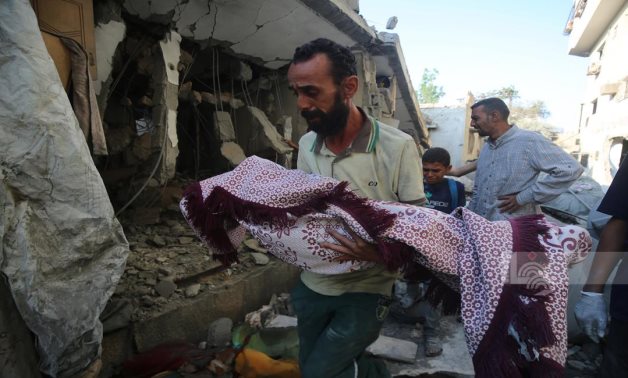
Families bid farewell to their loved ones who were killed by Israel during the war in Gaza - WAFA




CAIRO – 16 August 2025: Israeli forces are preparing to relocate civilians in Gaza toward the south ahead of a widely condemned plan to impose full Israeli security control over the entire enclave.
Israeli army spokesman Avichay Adraee said the move aims to ensure the “safety” of civilians in Gaza by moving them away from “combat zones.”
Israeli forces have repeatedly launched airstrikes on areas they had previously designated as “safe,” including Al-Mawasi Camp as well as locations in Khan Younis and Rafah in southern Gaza, killing scores of civilians.
Adraee noted that the provision of tents and shelter equipment for Gaza residents will resume starting Sunday.
He added that the equipment will be transported via the Karm Abu Salem crossing by the United Nations and international aid organizations, after undergoing “thorough inspection” by Israeli forces.
Displacing Palestinians
Israel and the United States have repeatedly promoted plans to forcibly relocate Gazan civilians southward toward Egypt—a move strongly rejected by Cairo, the Arab world, and much of the international community.
Earlier in August, President Abdel Fattah El-Sisi reaffirmed his condemnation of Israel’s “war of starvation and genocide,” emphasizing that Egypt—serving as a key gateway for humanitarian aid into Gaza—will not facilitate the displacement of Palestinians from their land.
The Israeli government earlier this month approved a plan to seize Gaza City, located in the north of the enclave and home to hundreds of thousands of civilians—many of whom have been displaced multiple times since the war began.
The five-point plan includes imposing Israeli “security control” over the entire Gaza Strip, disarming Hamas, returning all captives, ensuring Gaza’s full demilitarization, and establishing a new civil administration unaffiliated with either Hamas or the Palestinian Authority.
Israeli media reports indicate the operation will begin with a full takeover of Gaza City, while involving the forced relocation of up to one million residents to the south.
The decision has raised alarm over worsening humanitarian conditions, as Israel’s military campaign has already displaced the entire population and left the enclave on the brink of famine—with dozens of starvation-related deaths reported.
Renewed Ceasefire Talks
Egypt and Qatar, the Arab mediators in indirect ceasefire talks between Hamas and Israel, are working to bring back negotiations on the track.
Last week, Egypt received a high-level Hamas delegation led by political bureau chief Khalil Al-Hayya, who met with Egyptian intelligence chief Hassan Rashad. Hamas reaffirmed its commitment to continuing the talks.
Meanwhile, Israeli Mossad Director David Barnea visited Doha on Thursday for a meeting with Qatari Prime Minister Mohammed bin Abdulrahman Al-Thani.
Two Israeli officials told Reuters that the meeting aimed to restart negotiations over a captive deal and a possible ceasefire.
Israel’s plan to reoccupy Gaza has drawn sharp criticism across the Arab world and internationally—including from some of its closest Western allies.
The European Union (EU), France, Germany, Italy, the United Kingdom, Norway, Austria, Canada, Australia and New Zealand have jointly slammed the Israeli move.
Meanwhile, Germany has suspended all arms exports to Israel in response.
The move has also triggered protests both within Israel and abroad.
Since the start of the war in Gaza in October 2023, Israel has killed nearly 62,000 people, according to the enclave’s Health Ministry.
Additionally, 251 people—108 of them children—have reportedly died from starvation and malnutrition amid Israel’s heavy restrictions on aid, which amounted to a full blockade for almost three months this year.

Be Social




Comments
Leave a Comment