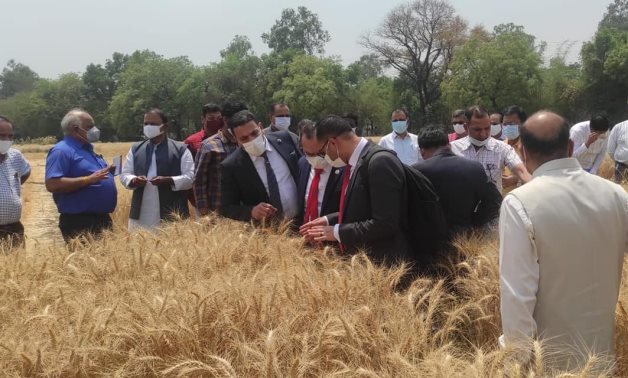
The Egyptian delegation of the Ministry of Agriculture visits a wheat field in India- Press photo




CAIRO – 21 August 2025: Egypt's Vision 2030 places special priority on developing the agricultural sector, considering it a cornerstone of both national food security and sustainable development. The vision focuses on integrated water resource management, rationalizing water use, and improving water quality by utilizing non-traditional sources.
The vision aims to increase the percentage of agricultural land benefiting from water-efficient practices to 100% by 2030, a significant leap from the nearly 30% recorded in 2023/2024. The strategy also highlights the importance of expanding the production of key crops and improving overall productivity by cultivating high-quality varieties and providing high-yield seeds for strategic crops.
The development of the agricultural land tenure system through the "farmer's card" is a crucial tool for implementing modern technological solutions. This ensures the optimal use of agricultural lands and helps prevent erosion or fragmentation. In line with the country's digital transformation, Egypt's Vision 2030 also emphasizes the role of digital transformation and smart farming to enhance the sector's ability to boost productivity and rationalize the use of subsidized fertilizers. Furthermore, it highlights the importance of leveraging modern technologies to combat climate change.
Other key goals include expanding livestock and dairy production projects to meet growing local demand. This is happening in parallel with efforts to increase arable land through land reclamation and cultivation projects, with the aim of maintaining a stable per capita share of agricultural land at 2.2 qirats per citizen.
The updated strategy for sustainable agricultural development confirms that the sector is a primary engine for strengthening the trade balance by increasing agricultural exports and reducing dependency on imports. It also contributes to enhancing food security and achieving higher levels of self-sufficiency, which in turn supports economic and social stability.
The government is prioritizing both horizontal and vertical expansion in agriculture, focusing on crops that are more resilient to climate change, expanding green spaces, and applying sound water management practices.
The 2025/2026 Socio-Economic Development Plan underscores the dual importance of the agriculture and irrigation sectors. On one hand, they are a fundamental pillar of national food security, and on the other, a vital support for boosting the productive capabilities of national industries and their related transport, trade, and logistics activities.
The plan notes that agriculture is the main source of income and employment in rural areas, where over 50% of the population relies on agricultural activities, including animal, poultry, and fish production, as well as related transport, storage, and marketing services.
From an economic perspective, the agricultural sector contributes to increasing the gross domestic product (GDP), driving growth in other economic sectors, and reducing imports, which strengthens the country's trade position. From a social perspective, agriculture remains a primary source of productive job opportunities for rural populations and helps reduce poverty and the gap between rural and urban areas.
Environmentally, agriculture plays a crucial role in expanding green spaces through horizontal expansion projects, reducing product waste, using sustainable water management practices, and gradually shifting towards farming methods that are more compatible with climate change.
Ultimately, agriculture plays a pivotal role in boosting the state's foreign currency reserves through increased exports, which strengthens the country's standing in global markets. The sector's interconnected relationships with other economic sectors stimulate growth and generate added value that drives comprehensive development.
Thus, the 2025/2026 development plan highlights the integration of the three dimensions of sustainable development—economic, social, and environmental—in the agriculture and irrigation sectors, all within the framework of Egypt's Vision 2030. This vision confirms that investing in food security is no longer an option but a national necessity to ensure a sustainable future for coming generations.

Be Social




Comments
Leave a Comment