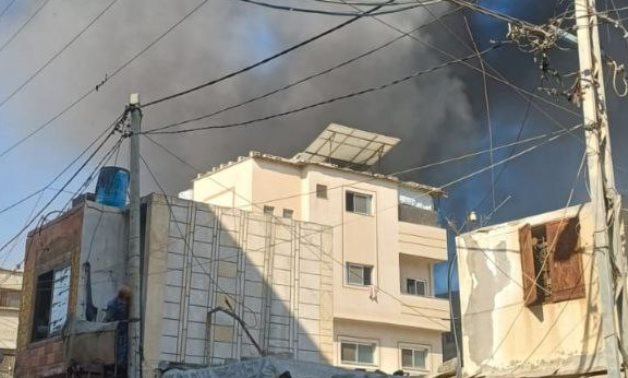
An Israeli airstrike targeted the home of the Abu Jiab family in the Al-Ma'askar area, northwest of Deir al-Balah, in the central Gaza Strip- photo from Journalist Hani El Shaer’s Telegram channel




CAIRO – 7 October 2025: The Israeli military has maintained intense artillery and aerial bombardment since last night through Tuesday morning, resulting in ongoing civilian fatalities and injuries.
Medical sources confirm the killing of at least 3 citizens and the wounding of others following shelling in the Al-Sabra neighborhood south of Gaza City. Additionally, several citizens were injured in artillery fire targeting a residential apartment in the Al-Rimal neighborhood in central Gaza.
Attacks persist across Gaza City’s southern and northwestern areas, with massive explosions reported in Al-Karama, the Intelligence Towers area, and the neighborhoods of Tal al-Hawa, Al-Rimal, Sheikh Radwan, Al-Nasr, and Al-Shati refugee camp. The Israeli military recently detonated an explosive-laden vehicle in the Al-Nasr neighborhood. Israeli warplanes are conducting low-altitude flights, while helicopters fire shots over Khan Younis in the south.
The war on the Gaza Strip now enters its second year, with a preliminary toll reaching 67,160 fatalities—predominantly children and women—and 169,679 injured. The actual toll is feared to be much higher, as many victims remain trapped under rubble, inaccessible to ambulance and rescue teams.
Two years into the Israeli war, the profound scope of a major cultural genocide is becoming starkly visible. The destruction has not been limited to physical infrastructure but has systematically targeted the collective memory, national identity, and cultural landscape of the Palestinian people.
Libraries have been burned, museums demolished, and cultural centers leveled. Institutions dedicated to memory, education, and the arts have been reduced to rubble, reflecting a deliberate strategy to erase Palestinian history and cultural identity.
The Palestinian National Library has documented the massive destruction of cultural heritage, confirming that the structural components of cultural life—including historical sites, educational, and artistic institutions—have suffered catastrophic damage.
Israeli authorities are employing systematic strategies to blot out Palestinian culture and steal its identity. These actions are not mere collateral damage but represent a strategic policy with roots predating 1948.
Targeting cultural, artistic, and educational centers, alongside archaeological and religious sites, serves clear political objectives. These institutions are not just spaces for creativity; they are vital tools for expressing collective memory and community resilience. The destruction of these organizations aims to erode the community's ability to preserve and transmit its cultural heritage, enabling the occupying power to impose dominance by emptying the national heritage of its cultural and political meaning.
Museums and Antiquities: All museums in Gaza have been targeted, including the National Museum (Al-Basha Palace), which housed tens of thousands of artifacts. Reports indicate some relics were destroyed while others were looted by Israeli soldiers and photographed in Israeli museums.
Libraries and Archives: The war has annihilated dozens of public, private, academic, and historical libraries, print houses, and publishing firms. Notable losses include the Great Omari Mosque Library (which lost over 190 of its 230 rare historical manuscripts) and the libraries of universities like Al-Aqsa, Al-Israa, and Islamic University, the latter losing over 240,000 books and references.
Historical Archives: Gaza’s Central Archive, containing documents and maps over 150 years old, was destroyed. Furthermore, Israeli forces seized control of the Gaza Antiquities Warehouse, containing thousands of artifacts spanning from 3000 BCE to the early Islamic era.
The systematic targeting of the academic, artistic, and intellectual elite poses a grave threat to Gaza's future. Over 150 scientists, academics, and university professors have been killed, alongside approximately 254 journalists and dozens of writers, poets, and artists. The destruction of their platforms and tools further weakens the cultural and scientific structure of the society.
Destruction of Education and Heritage Sites:
Education Sector: Around 95% of schools and universities have been damaged, depriving over 650,000 students of education. Over 18,000 students, 1,500 university students, 750 teachers, and over 230 university professors have been killed.
Religious and Historical Sites: At least 226 archaeological sites have been damaged. The damage extends to historic buildings like Beit Al-Saqqa (Ottoman era), Al-Kamilia School, and Al-Samra Bath (the last Ottoman bath in Gaza).
Religious Sites: Four ancient churches, including the Saint Porphyrius Church (the third oldest church in the world), and over 1,000 mosques have been completely or partially destroyed, including the Great Omari Mosque and the Sayed Hashim Mosque. Eight cemeteries have been entirely destroyed, with the bulldozing of 600 graves in the Beit Hanoun cemetery.
The Palestinian National Library urgently calls on the international community to provide protection for Palestinian cultural heritage in the Gaza Strip. It emphasizes that cultural property belongs to all of humanity and that an attack on it constitutes an attack on all the world's peoples. The Library demands adherence to the 1954 Hague Convention, which prohibits the destruction of and damage to cultural heritage during armed conflicts.

Be Social




Comments
Leave a Comment