
Egyptian industries are facing new pressure to measure and reduce carbon emissions under Europe’s CBAM rules - EGYPT TODAY




CAIRO • AUGUST 1, 2026


Inside an Egyptian factory exporting steel, cement, fertilizers or chemicals to Europe, the challenge is no longer limited to product quality, price or delivery schedules.
Increasingly, it is also about carbon.
With the European Union moving ahead with its Carbon Border Adjustment Mechanism, known as CBAM, exporters will have to prove the volume of carbon emissions embedded in their products. Failure to do so could expose companies to additional costs that may weaken their competitiveness in one of Egypt’s most important export markets.
For heavy industries such as iron and steel, cement, fertilizers and chemicals, the issue is no longer purely environmental. It has become a trade, investment and industrial policy question.
The EU remains a key trading partner for Egypt, while United Nations estimates suggest that around 27 percent of global emissions are linked to the production and transport of internationally traded goods.
That reality has pushed Europe to create a system that attaches a carbon cost to imports from countries with less stringent climate-pricing rules.
For many manufacturers, CBAM looks like another burden placed on exporters. But for researchers and policymakers, it could also become a turning point for Egypt’s industrial transformation, provided the country can build the right ecosystem of data, finance and legislation.
The question is no longer whether CBAM will affect Egypt. That effect has already begun.
That vision was at the center of policy consultations organized by the Future of Inclusive Development in Egypt project, known as FIDE, at the American University in Cairo’s School of Global Affairs and Public Policy.
The three-year Swiss-funded research and development project aims to support policies linked to the green transition and help shape a strategy for dealing with CBAM.
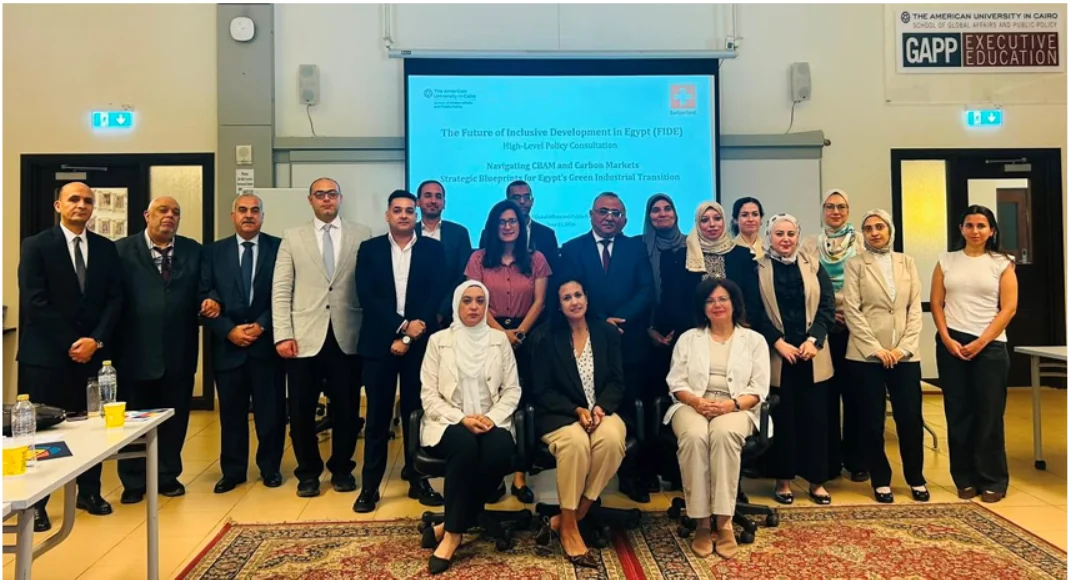
Researchers, policymakers, legislators, private sector representatives, and development partners discussed how Egypt could transform CBAM compliance from an external burden into a driver of industrial modernization.
Ghada Barsoum, professor and chair of the Department of Public Policy and Administration at AUC’s School of Global Affairs and Public Policy and lead of the project’s sustainability component, said the initiative is focused on producing practical, implementable recommendations.
She said the project works on Arabic policy papers and policy briefs that support Egypt’s shift toward environmental sustainability, with analytical focus on the challenges of the green transition, environmental, social and governance indicators, and the infrastructure needed for carbon markets under international climate regulations.
Barsoum explained that the initiative brings together senior policymakers, legislators, private sector representatives, development partners and academics through policy-level consultations.
These sessions aim to identify research priorities, regulatory challenges and required policy actions, while also providing evidence-based support for parliamentary discussions on decarbonization and trade resilience.
The message emerging from the consultations is that CBAM should not be treated only as a European pressure tool. It could also become a catalyst for modernizing Egyptian industry, improving production efficiency, and protecting export access.
.png "What is CBAM and why should Egyptian exporters care?")
Hani Qaddah, markets expert and executive director of the Ready-Made Garments Chamber, warned that some export shipments have already faced problems related to carbon certificate requirements.
He said some European markets are now requiring exporters to meet these conditions before allowing products to enter, while other markets are still granting a transition period until 2027.
Qaddah explained that CBAM compliance reports require review by accredited entities or experts to verify the carbon emissions generated by each factory.
This means companies cannot wait until the new rules become a full commercial barrier. They need to start improving energy efficiency and lowering consumption now.
Initial emissions reductions do not always require major capital investment.
These measures can reduce emissions while improving companies’ ability to comply with CBAM requirements.
Qaddah pointed to Morocco as a useful example, saying it had succeeded in moving forward with the environmental measures required to prepare its industries for changing global trade rules.
Although more Egyptian companies are gradually engaging with sustainability requirements, the main obstacle remains the absence of accurate emissions data.
A research paper titled “Is Egypt Ready for the EU Carbon Border Adjustment Mechanism? Evidence from Firm-Level Data,” published in August 2025 by Springer Nature, highlighted a serious gap in emissions reporting among Egyptian firms.
The study was based on data from 455 Egyptian companies operating in the sectors most affected by CBAM. It sought to answer a central question: is Egypt ready to deal with the mechanism?
Yasmine Kamal, assistant professor of economics at Cairo University and lead researcher of the study, said only a limited share of these companies measure energy consumption or prepare environmental reports regularly.
Most firms, especially small and medium-sized enterprises, still lack proper systems for measuring and reporting emissions.
Without reliable emissions data, companies struggle to prove their carbon footprint, while the state has less ability to negotiate, design incentives, or target support toward the sectors most exposed to climate-linked trade measures.
For Kamal, the problem goes beyond compliance with EU regulations. It also reflects the absence of a national database that Egypt can use to guide industrial and environmental policymaking.
Without reliable data, companies face greater difficulty proving their carbon footprint. At the same time, the state has less room to negotiate, plan incentives or design targeted support for sectors most exposed to climate-linked trade measures.
Rana Hendy, assistant professor at AUC’s School of Global Affairs and Public Policy, said the proposal that received the widest support during the consultations was the creation of a national monitoring, reporting and verification system, known as MRV.
Such a system would connect government bodies and the private sector through a unified platform capable of measuring emissions in a precise and documented way.
Hendy said the proposal builds on existing institutional foundations, including the environmental verification and accreditation unit established at the General Organization for Export and Import Control in 2023.
It also links with initiatives implemented by the German development agency GIZ and the World Bank.
If Egypt owns and manages its own emissions data, it can negotiate from documented national evidence instead of relying on external estimates.
For exporters, this could make the difference between reacting to European requirements and entering negotiations with documented national evidence.
.png "How Egyptian exporters can adapt to CBAM")
Egypt’s chemical and fertilizer industries have already begun preparing for the new carbon rules.
Khaled Abu El Makarem, chairman of the Chemical and Fertilizers Export Council, said the council moved early to prepare for CBAM because of the importance of the European market, which he described as the largest and most important trading partner for the sector’s exports.
EU countries account for around 40 percent of Egypt’s total chemical industry exports, he said.
Abu El Makarem noted that once the EU announced CBAM, the council intensified its work to raise exporters’ readiness.
This included organizing workshops and training programs to explain the mechanism, its requirements and ways to comply with European regulations.
The council also participated in the ministerial committee responsible for following up on CBAM implementation, with the aim of ensuring that Egyptian companies can deal with the new system without losing competitiveness.
Abu El Makarem said the council trained executive staff on calculating the carbon footprint of products so they can provide technical support to exporting companies.
The sector’s dependence on Europe makes early compliance, carbon reporting, energy efficiency, and production-line modernization particularly important.
He added that compliance with environmental and sustainability standards is not only a challenge, but also an opportunity to increase the share of Egyptian products in European markets over the coming years.
The chemical industries sector is already moving toward better energy efficiency and more sustainable production technologies, he said.
However, expanding clean energy use and upgrading production lines require additional investment, making government support programs essential.
He also pointed to a growing trend toward localizing advanced chemical industries based on modern technology, which could raise value added and strengthen the competitiveness of Egyptian industry.
Over the past five years, new investments from Chinese, Turkish and other companies have entered the sector, a development expected to support production growth and exports in the coming period.
Data alone will not be enough.
According to Kamal’s study, around 17 percent of companies face financing constraints that limit their ability to invest in low-emission equipment and technologies.
High interest rates make the cost of the green transition heavier for Egyptian companies compared to their European competitors.
The study noted that loan interest rates approaching 20 percent make the capital investments needed for decarbonization expensive, especially when firms need to upgrade machinery, equipment and vehicles.
Some firms cannot afford the equipment and technologies required for lower-emission production.
High borrowing costs make industrial decarbonization more expensive for Egyptian manufacturers.
Although concessional financing programs are available through development banks, their use remains limited.
The reasons include weak incentives and the fact that many companies do not have the creditworthiness required to access such financing.
The AUC consultations discussed the need for a dedicated financing mechanism for the green transition, potentially led by the Central Bank of Egypt in cooperation with international development banks.
Participants also called for grants and technical assistance, especially for small and medium-sized enterprises.
Experts involved in the discussions argued that any climate policy will remain limited unless it is matched with affordable financing that enables companies to modernize their production lines.
However, they also warned that finance alone will not solve the problem. A trusted emissions measurement system is often a basic condition for accessing many green finance programs.
Data and finance are not separate tracks. They are two sides of the same transition.
Legislation is the third part of the equation.
Member of Parliament Ahmed Fayez said drafting a proactive national strategy is essential to protect the competitiveness of Egyptian industry, secure export access to European markets, reduce CBAM-related risks and support the shift toward a sustainable low-emission economy.
Fayez reviewed Egypt’s first draft law for carbon governance, which aims to create an integrated national framework for regulating carbon emissions.
The proposed law would support a sustainable circular economy, align Egypt with advanced international environmental standards and use the economic returns generated by the framework to improve company efficiency, support communities most affected by climate change and strengthen the competitiveness of Egyptian exports.
Fayez said the draft includes the establishment of a national MRV system, a carbon pricing mechanism, a market for trading carbon credits and financial incentives to support companies and fund emissions-reduction projects.
He added that the bill had already secured signatures from more than one-tenth of House of Representatives members, paving the way for its inclusion on Parliament’s agenda.
A clear legislative framework, he said, would give investors and industrial players a more stable view of the future of Egypt’s low-carbon economy.
Still, the existence of proposed legislation and possible financing does not mean the path is clear.
Barsoum said that while participants in the consultations agreed on the need for a new strategy and urgent action, they also highlighted challenges that could slow implementation.
These include disagreement over which body should lead Egypt’s carbon governance system, how different ministries should coordinate their roles and whether Egypt should issue a standalone carbon law or integrate carbon governance into the existing environmental law.
Other concerns include the absence of a unified sustainability reporting model, weak awareness among many suppliers about CBAM requirements and the high cost of compliance.
All of these factors could delay the readiness of Egyptian companies unless they are addressed through a coordinated national plan.
Egypt must decide which institution will lead national carbon governance.
Ministries and regulatory bodies need clearly defined and coordinated responsibilities.
Companies still lack a unified national model for sustainability and emissions reporting.
Many industrial suppliers remain unfamiliar with CBAM requirements and timelines.
Verification, equipment upgrades, cleaner energy, and technical support can impose significant costs.
Perhaps the most important message from the consultations, which are expected to feed into the green transition chapters of FIDE’s upcoming policy book, is that Egypt should not approach CBAM as a foreign crisis imposed from outside.
Instead, it should treat it as an opportunity to restructure national industry.
Rather than simply trying to avoid European carbon fees, participants called for clear Egyptian environmental targets and stronger links between industrial, investment and sustainability policies.
Under this approach, the green transition would become part of Egypt’s economic development strategy, not just a response to external pressure.
The question is no longer whether CBAM will affect Egypt. That effect has already begun.
The real question is whether Egyptian industry will enter this transformation prepared, with its own data, financing tools and legal framework, or whether it will remain in a race to catch up with rules written elsewhere.
A trusted national system capable of measuring and verifying industrial emissions.
Affordable funding that allows factories to upgrade equipment and adopt cleaner technologies.
A clear and stable carbon governance framework supporting investment and industrial competitiveness.
CBAM presents Egyptian industry with a difficult adjustment, but it also creates an opportunity to modernize factories, improve energy efficiency, localize cleaner technologies, and build a national carbon market supported by trusted data.
Whether Egypt protects and expands its access to European markets may depend on how quickly the country can connect industrial policy with environmental targets, affordable green finance, emissions reporting, and a clear legislative framework.

Be Social



Comments
Leave a Comment